

Curated Bulb Selection
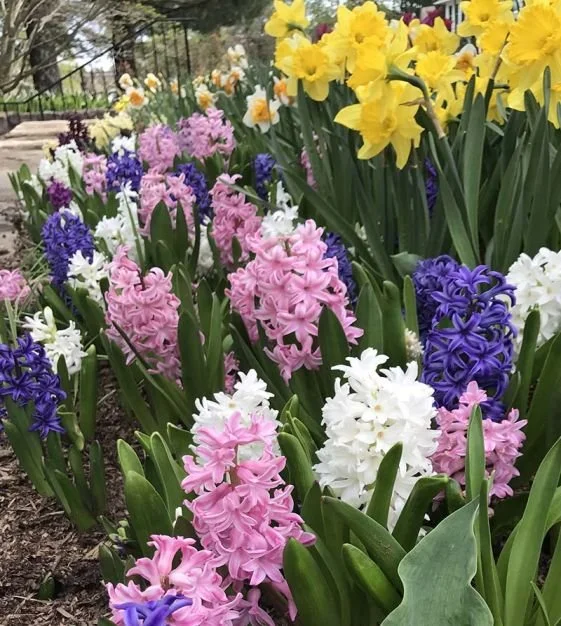
This Hyacinth Bedding Mixture is a vibrant blue, pink and white blend of five varieties of Hyacinth orientalis: Aiolos, Blue Jacket, Delft Blue, Carnegie, Fondant and Pink Pearl. Not only are the size 15/16 centimeter bulbs more economical for larger drifts and swaths, but this bulb size removes the possibility of having to stake to plump, rigid flowering racemes. Bulb size: 15/16 cm. Full to partial sunlight. Bloom time in horticultural zone 5: April. Plant 6" deep and 6" apart. HZ: 4-8. Height: 8" to 12".
Tips for reblooming each year:
Hyacinths are famous for their intense fragrance and vibrant burst of color that signals the arrival of spring. While botanically perennial, the common garden hyacinth (Dutch Hyacinth) requires specific post-flowering care and local climate conditions to reliably produce the same quality of bloom year after year. Understanding the difference between a botanical perennial and a successful garden perennial is key to enjoying these bulbs for more than one season.
Understanding Hyacinth Perenniality
The common Dutch Hyacinth (Hyacinthus orientalis) is classified as a perennial geophyte, meaning its bulb naturally lives for multiple years. However, in garden settings, it is often treated as an annual because its vigor declines rapidly after the initial spectacular display. The massive, densely packed flower spike seen in the first year results from extensive commercial preparation and nutrient loading within the bulb.
The bulb reproduces asexually by forming small offsets (bulblets) around the base. This process causes the original bulb to divide and lose mass over time. Subsequent blooms often appear smaller and less dense than the initial display, which is why many gardeners replace the bulbs each autumn.
Essential Care for Reblooming
To maximize the chances of a return bloom, careful attention must be paid to the bulb immediately after the flowers fade. The first action is deadheading, which involves removing the spent flower spike down to the foliage line. This prevents the plant from expending energy on developing seeds, redirecting resources into strengthening the bulb for the following season.
The green leaves must remain attached until they have completely withered and turned yellow or brown, typically six to eight weeks after flowering. During this time, the leaves actively photosynthesize, producing carbohydrates stored in the bulb to fuel next year’s growth.
While the foliage is still green, apply a low-nitrogen, high-potassium fertilizer formulated for bulbs to replenish depleted nutrients. Once the foliage has died back naturally, it can be cut down, and the bulb enters its required summer dormancy.
Distinguishing Dutch and Grape Hyacinths
The common garden hyacinth (Hyacinthus orientalis) is often confused with the Grape Hyacinth (Muscari), which belongs to a different genus. Grape Hyacinths are characterized by small, tightly clustered, bell-shaped flowers resembling a bunch of grapes.
Muscari bulbs are significantly more vigorous and reliably perennial than their Dutch counterparts. They naturalize easily, spreading and multiplying rapidly through both bulb offsets and self-seeding, often forming dense carpets of blue or white flowers. This aggressive perennial nature makes Muscari a simpler choice for gardeners seeking a guaranteed return bloom year after year with minimal intervention.
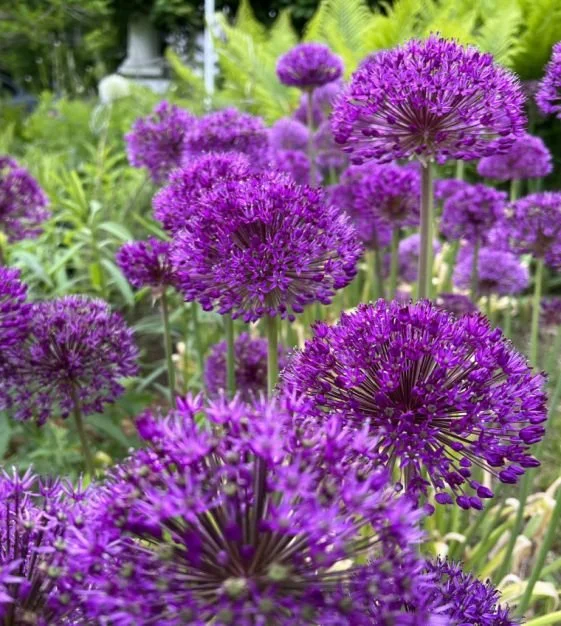
Allium 'Purple Sensation'
Ornamental onion
'Purple Sensation' produces a 4-5 inch ball of vivid violet-purple flowers on 24-30 inch stalks.
Blooms early spring
Full to part sun
Care:
Remove spent leaves and flowers as desired. Often, the dried seed heads add extended interest in the garden.
Culture
Easily grown in average, dry to medium moisture, well-drained soils in full sun to part shade. Best in full sun, but appreciates some light afternoon shade in hot summer climates. Tolerates a wide range of soils. Performs well in sandy soils. Bulbs are best planted in fall.
Noteworthy Characteristics
The genus Allium contains over 700 species of bulbous or rhizomatous plants. All possess oniony smelling flowers and foliage. Some species are grown for culinary purposes and others for ornamental purposes. Plants typically produce showy flower umbels on naked scapes rising above a clump of linear grass-like leaves. Ornamental alliums generally range in height from 3” to 4-6’ tall.
Genus name comes from the classical Latin name for garlic.
Problems
Bulb rot may occur in overly moist soils. Deer and rabbits tend to avoid this plant.
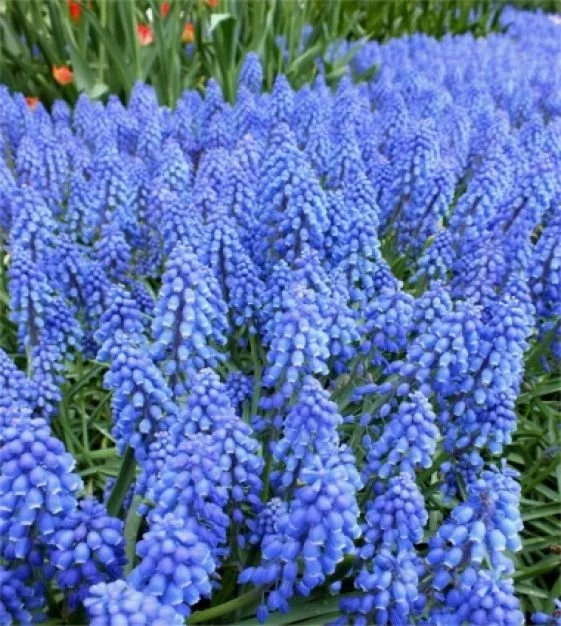
Considered to be the original Blue Grape Hyacinth, M. armeniacum is one of the most prolifically planted bulbs of all time. A native of Turkey, circa 1878, it yields one to three conical racemes of densely packed, electric cobalt-blue florets with narrow white rims above ample foliage clumps. Bulb size: 9 cm/up. Full to partial sunlight. Bloom time in horticultural zone 5: April. Plant 5" deep and 3" to 4" apart. HZ: 4-8. Height: 8" (or a little taller).
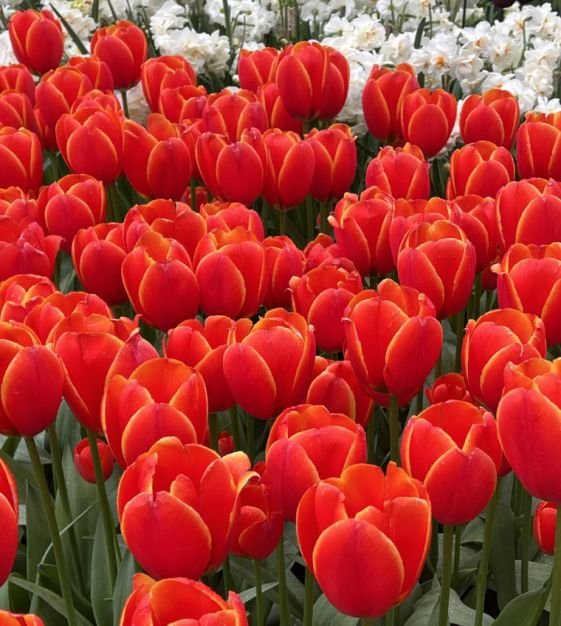
This award-winning, gleaming powerhouse has strong, huge, tomato-red flowers with golden-yellow petal edges and an interior yellow spotlight base. (Garden visitors may secretly feel the flower petals to see if they are silk or real~they are perfect flowers.) Tulip Class: Giant Darwin Hybrid. Bulb size: 12 cm/up. Mid-April. HZ: 3-7. Height: 18".
Encouraging Tulips to return more than one year in our area:
Drainage is the most important soil factor for perennial tulips. Bulbs sitting in waterlogged soil rot, and this is probably the most common reason tulips don’t come back after the first year. If your soil is heavy clay or stays wet after rain, you’ll need to improve it before planting.
Work compost into the planting area to improve the structure. Raised beds are another option if your native soil just doesn’t drain well enough. The goal is soil that lets water pass through rather than pooling around the bulbs, especially during summer dormancy when the bulbs are resting and most vulnerable to rot.
Another tip is to plant the bulbs slightly deeper than the standard recommendation. About eight inches deep tends to produce better results for perennializing than the more common six inches. Deeper planting keeps the bulbs cooler in summer, protects them from squirrels, and encourages stronger root development.
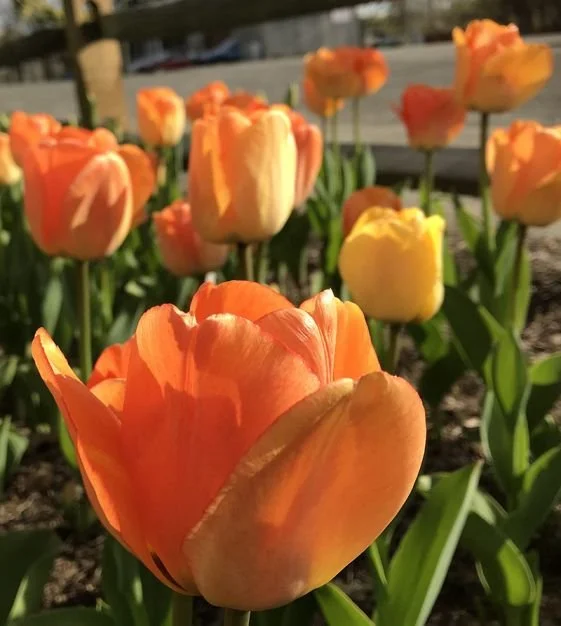
I’ve had quite a bit of success locally with this tulip returning for several years in a row.
Day Dream is one of the most incredible color-shifting magicians ever. This 1980 hybrid opens yellow with a variable infinitesimal crimson edge, and morphs to all shades of soft apricot and warm orange, sometimes with a rosy glow. Its delightful fragrance adds to its charms. Tulip Class: Giant Darwin Hybrid. Bulb size: 12 cm/up. Mid-April. HZ: 3-7. Height: 22".
Encouraging Tulips to return more than one year in our area:
Drainage is the most important soil factor for perennial tulips. Bulbs sitting in waterlogged soil rot, and this is probably the most common reason tulips don’t come back after the first year. If your soil is heavy clay or stays wet after rain, you’ll need to improve it before planting.
Work compost into the planting area to improve the structure. Raised beds are another option if your native soil just doesn’t drain well enough. The goal is soil that lets water pass through rather than pooling around the bulbs, especially during summer dormancy when the bulbs are resting and most vulnerable to rot.
Another tip is to plant the bulbs slightly deeper than the standard recommendation. About eight inches deep tends to produce better results for perennializing than the more common six inches. Deeper planting keeps the bulbs cooler in summer, protects them from squirrels, and encourages stronger root development.