

 Image 1 of 2
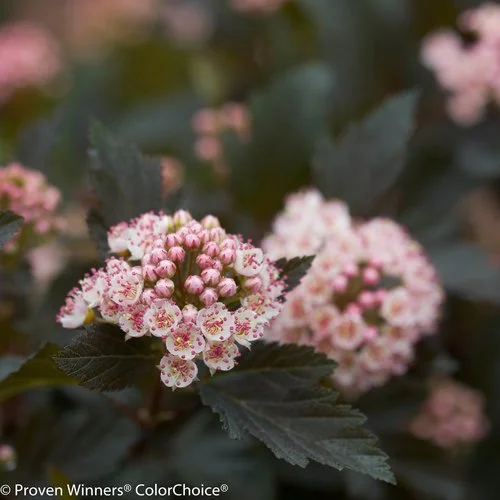 Image 2 of 2
physocarpus opulifolius ‘Summer Wine’
Plant Type: Shrub
Shrub Type: Deciduous
Garden Height: 60 - 96 Inches
Spread: 60 - 96 Inches1.5m - 2.4m
Flower Colors: Pink
Foliage Colors: Purple
Habit: Upright
Native to North America
Light Requirement: Sun
Maintenance Category: Easy
Blooms On: Old Wood
Bloom Time: Late Spring
Water Category: Average
Maintenance Notes:
Adaptable to difficult situations. Withstands acidic and alkaline soils. Medium moisture is best but can tolerate dry conditions once established, making this summer wine ninebark a resilient landscape option. Prefers open sites with good air circulation. This variety has good resistance to powdery mildew. It is best to avoid regular pruning of ninebarks, which disrupts their naturally elegant habit, especially on a mature dark foliage shrub. However, if you wish to prune a ninebark shrub selectively, do so immediately after flowering in spring. Will not bloom heavily in shade.
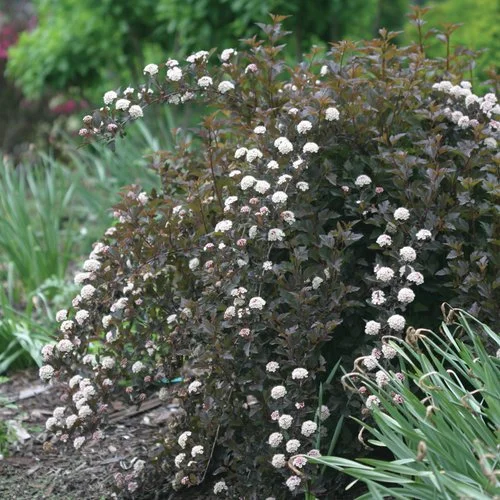
SUMMER WINE is noted for its deeply cut, wine-red foliage and its dense, free-branching, mounded growth habit. It is the result of a cross between P. opulifolius ‘Nanus’ (seed parent) and P. opulifolius ‘Diabolo’ (pollen parent). It typically grows 4-6’ tall and as wide, but, unlike the species, is noted for retaining compact form. Small pinkish-white, five-petaled flowers in dense, flat, rounded, 1-2” diameter, spiraea-like clusters (corymbs) appear in late spring. Ovate to rounded, usually 3-5 lobed leaves (to 4” long) are wine red. Foliage color tends to green up in hot summer climates as the summer progresses. Ninebark is named for its exfoliating bark (on mature branches) which peels in strips to reveal several layers of reddish to light brown inner bark. Bark provides winter interest but is usually hidden by the foliage during the growing season. U.S. Plant Patent PP14,821 issued May 25, 2004.
Physocarpus opulifolius, commonly called ninebark, is an upright, spreading, somewhat coarse, deciduous, native shrub which is closely related to the genus Spiraea. It typically occurs along streams, rocky banks, gravel bars and in moist thickets. Noted for its exfoliating bark (on mature branches) which peels in strips to reveal several layers of reddish to light brown inner bark (hence the common name of ninebark). Bark provides winter interest, but is usually hidden by the foliage during the growing season. Features small pink or white, five-petaled flowers appearing in dense, flat, rounded, 1-2” diameter, spirea-like clusters (corymbs) in late spring. Flowers give way to drooping clusters of reddish fruit (inflated seed capsules). Ovate to rounded, usually 3-5 lobed leaves (to 4” long) are dull green in summer changing to an undistinguished yellow in fall.
Genus name comes from the Greek physa meaning a bladder and karpos meaning fruit, referring to the inflated dry fruits of the plant.
Specific epithet refers to the leaves that resemble those of Viburnum opulus.
Common name of ninebark is in reference to its ornamental attractive exfoliating bark.
physocarpus opulifolius ‘Summer Wine’
Plant Type: Shrub
Shrub Type: Deciduous
Garden Height: 60 - 96 Inches
Spread: 60 - 96 Inches1.5m - 2.4m
Flower Colors: Pink
Foliage Colors: Purple
Habit: Upright
Native to North America
Light Requirement: Sun
Maintenance Category: Easy
Blooms On: Old Wood
Bloom Time: Late Spring
Water Category: Average
Maintenance Notes:
Adaptable to difficult situations. Withstands acidic and alkaline soils. Medium moisture is best but can tolerate dry conditions once established, making this summer wine ninebark a resilient landscape option. Prefers open sites with good air circulation. This variety has good resistance to powdery mildew. It is best to avoid regular pruning of ninebarks, which disrupts their naturally elegant habit, especially on a mature dark foliage shrub. However, if you wish to prune a ninebark shrub selectively, do so immediately after flowering in spring. Will not bloom heavily in shade.
SUMMER WINE is noted for its deeply cut, wine-red foliage and its dense, free-branching, mounded growth habit. It is the result of a cross between P. opulifolius ‘Nanus’ (seed parent) and P. opulifolius ‘Diabolo’ (pollen parent). It typically grows 4-6’ tall and as wide, but, unlike the species, is noted for retaining compact form. Small pinkish-white, five-petaled flowers in dense, flat, rounded, 1-2” diameter, spiraea-like clusters (corymbs) appear in late spring. Ovate to rounded, usually 3-5 lobed leaves (to 4” long) are wine red. Foliage color tends to green up in hot summer climates as the summer progresses. Ninebark is named for its exfoliating bark (on mature branches) which peels in strips to reveal several layers of reddish to light brown inner bark. Bark provides winter interest but is usually hidden by the foliage during the growing season. U.S. Plant Patent PP14,821 issued May 25, 2004.
Physocarpus opulifolius, commonly called ninebark, is an upright, spreading, somewhat coarse, deciduous, native shrub which is closely related to the genus Spiraea. It typically occurs along streams, rocky banks, gravel bars and in moist thickets. Noted for its exfoliating bark (on mature branches) which peels in strips to reveal several layers of reddish to light brown inner bark (hence the common name of ninebark). Bark provides winter interest, but is usually hidden by the foliage during the growing season. Features small pink or white, five-petaled flowers appearing in dense, flat, rounded, 1-2” diameter, spirea-like clusters (corymbs) in late spring. Flowers give way to drooping clusters of reddish fruit (inflated seed capsules). Ovate to rounded, usually 3-5 lobed leaves (to 4” long) are dull green in summer changing to an undistinguished yellow in fall.
Genus name comes from the Greek physa meaning a bladder and karpos meaning fruit, referring to the inflated dry fruits of the plant.
Specific epithet refers to the leaves that resemble those of Viburnum opulus.
Common name of ninebark is in reference to its ornamental attractive exfoliating bark.