

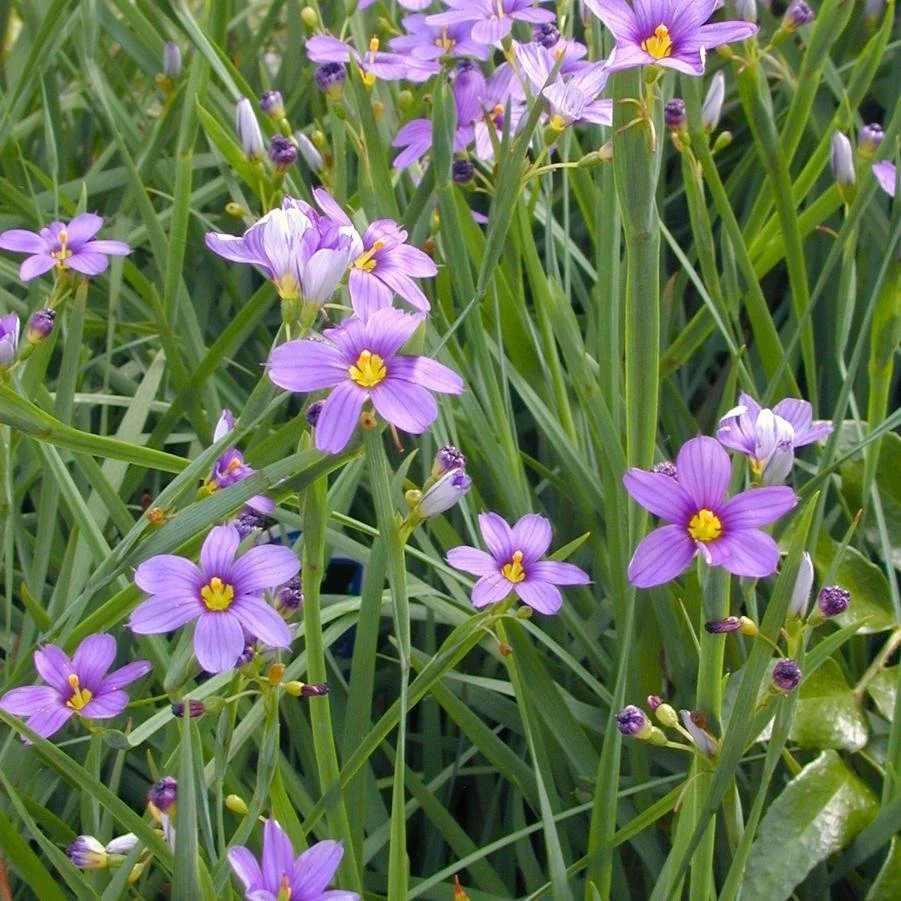
 Image 1 of 2
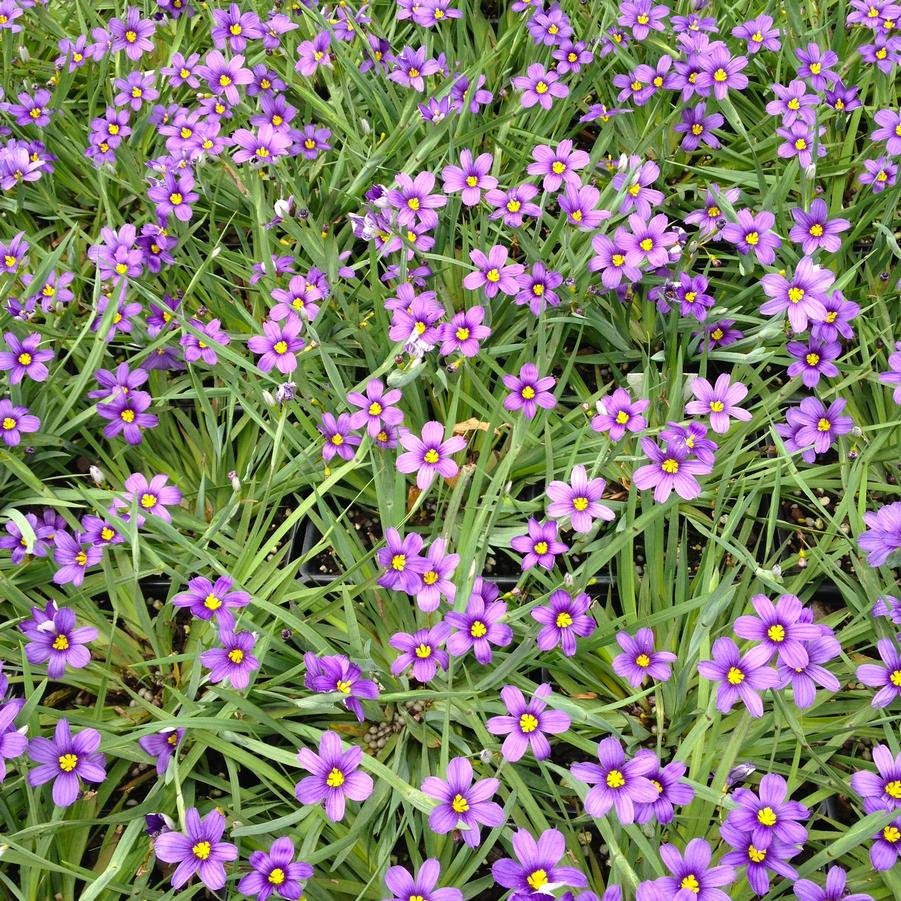 Image 2 of 2
Sisyrinchium angustifolium ‘Lucerne’
Bright blue stars on grass like foliage from May to August
Flowers open when the sun is out
Full sun to pt. shade
Moist to dry, poor to average soils, drought tolerant
Natural habitat: upland forests, meadows, fields, woods
Songbirds eat the seed
Deciduous
Category:Perennials, Native Selection
Hardiness Zone:5-8
Height:8-10 in
Spread:6-8 in
Bloom Color:Blue
Avoid heavy mulch
Blue-eyed grass is very low maintenance. If your larger clusters start looking messy or overgrown, trim the foliage or divide them and replant smaller clusters. Don’t mow the leaves low like your grassy lawn after these plants bloom. The leaves are needed to for photosynthesis.
Best grown in medium moisture, well-drained soil in full sun to part shade. Prefers consistently moist soils that do not dry out, but drainage must be good. Plantings may be sheared back after bloom to avoid any unwanted self-seeding and/or to tidy foliage for remaining part of the growing season. Plants may need to be divided every 2-3 years to keep plantings vigorous.
‘Lucerne’ reportedly does not vigorously self-seed as species plants often do.
Sisyrinchium angustifolium, commonly called blue-eyed grass, is noted for its violet-blue flowers and branched flowering stems. Though its foliage is grass-like, the blue-eyed grasses belong to the iris family not the grass family. It is a clump-forming perennial that features a tuft of narrow grass-like leaves (to 3/16" wide) typically growing to 12" (less frequently to 20") tall. Clusters of violet-blue flowers (to 1/2" across), each with 6 pointed tepals and a yellow eye, appear in spring on stalks growing from leaf-like bracts atop usually branched flowering stems which are distinctively flattened.
Genus name comes from the ancient Greek name for another plant.
Specific epithet means narrow-leaved.
‘Lucerne’ was discovered growing in a nursery near Lucerne, Switzerland. It is noted for its profuse bloom of large, one inch diameter, star-like, intense blue flowers with yellow centers over a long May-June bloom period.
No serious insect or disease problems.
Best naturalized in informal garden areas such as cottage gardens, woodland gardens, wild gardens or native plant areas. Also effective in border fronts, rock gardens and as an edger for paths or walkways.
Sisyrinchium angustifolium ‘Lucerne’
Bright blue stars on grass like foliage from May to August
Flowers open when the sun is out
Full sun to pt. shade
Moist to dry, poor to average soils, drought tolerant
Natural habitat: upland forests, meadows, fields, woods
Songbirds eat the seed
Deciduous
Category:Perennials, Native Selection
Hardiness Zone:5-8
Height:8-10 in
Spread:6-8 in
Bloom Color:Blue
Avoid heavy mulch
Blue-eyed grass is very low maintenance. If your larger clusters start looking messy or overgrown, trim the foliage or divide them and replant smaller clusters. Don’t mow the leaves low like your grassy lawn after these plants bloom. The leaves are needed to for photosynthesis.
Best grown in medium moisture, well-drained soil in full sun to part shade. Prefers consistently moist soils that do not dry out, but drainage must be good. Plantings may be sheared back after bloom to avoid any unwanted self-seeding and/or to tidy foliage for remaining part of the growing season. Plants may need to be divided every 2-3 years to keep plantings vigorous.
‘Lucerne’ reportedly does not vigorously self-seed as species plants often do.
Sisyrinchium angustifolium, commonly called blue-eyed grass, is noted for its violet-blue flowers and branched flowering stems. Though its foliage is grass-like, the blue-eyed grasses belong to the iris family not the grass family. It is a clump-forming perennial that features a tuft of narrow grass-like leaves (to 3/16" wide) typically growing to 12" (less frequently to 20") tall. Clusters of violet-blue flowers (to 1/2" across), each with 6 pointed tepals and a yellow eye, appear in spring on stalks growing from leaf-like bracts atop usually branched flowering stems which are distinctively flattened.
Genus name comes from the ancient Greek name for another plant.
Specific epithet means narrow-leaved.
‘Lucerne’ was discovered growing in a nursery near Lucerne, Switzerland. It is noted for its profuse bloom of large, one inch diameter, star-like, intense blue flowers with yellow centers over a long May-June bloom period.
No serious insect or disease problems.
Best naturalized in informal garden areas such as cottage gardens, woodland gardens, wild gardens or native plant areas. Also effective in border fronts, rock gardens and as an edger for paths or walkways.