

 Image 1 of 2
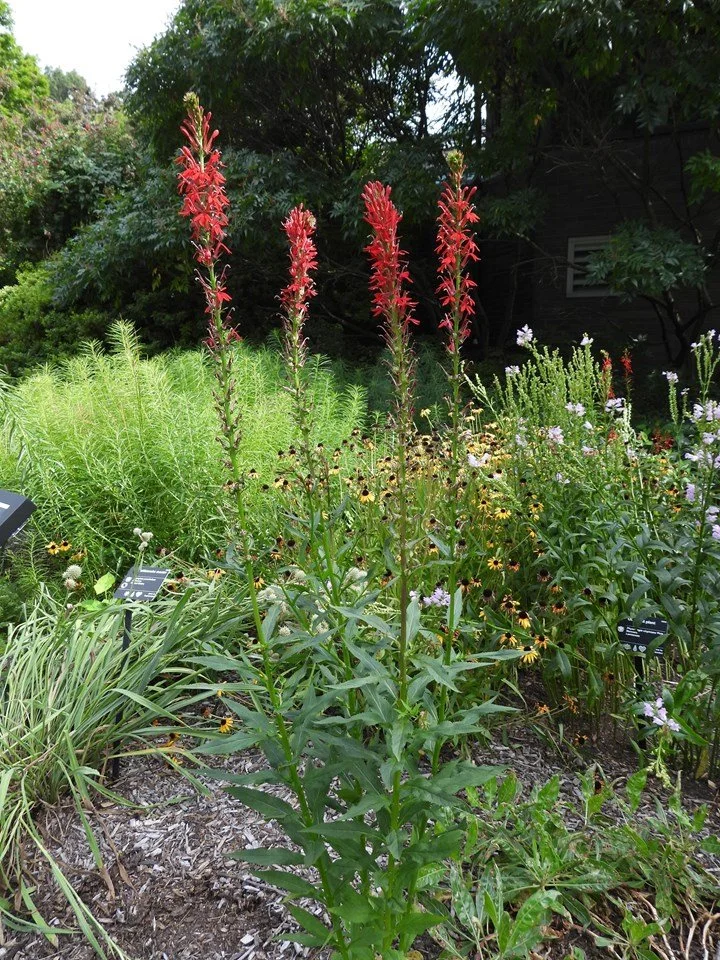 Image 2 of 2
Type: Herbaceous perennial
Height: 2-3 feet
Spread: 1-2 feet
Bloom Time: July to September
Bloom Description: Scarlet red, white or rose
Sun: Full sun to part shade
Water: Medium to wet
Maintenance: Low
Attracts: Hummingbirds, Butterflies
Tolerate: Rabbit, Deer, Wet Soil
Easily grown in rich, medium to wet soils in full sun to part shade. Needs constant moisture. Tolerates brief flooding. Soils should never be allowed to dry out. Will tolerate full sun in cool, northern climates, but otherwise appreciates part shade. Root mulch should be applied in cold winter climates to protect the root system and to prevent root heaving. Mulch will also help retain soil moisture.
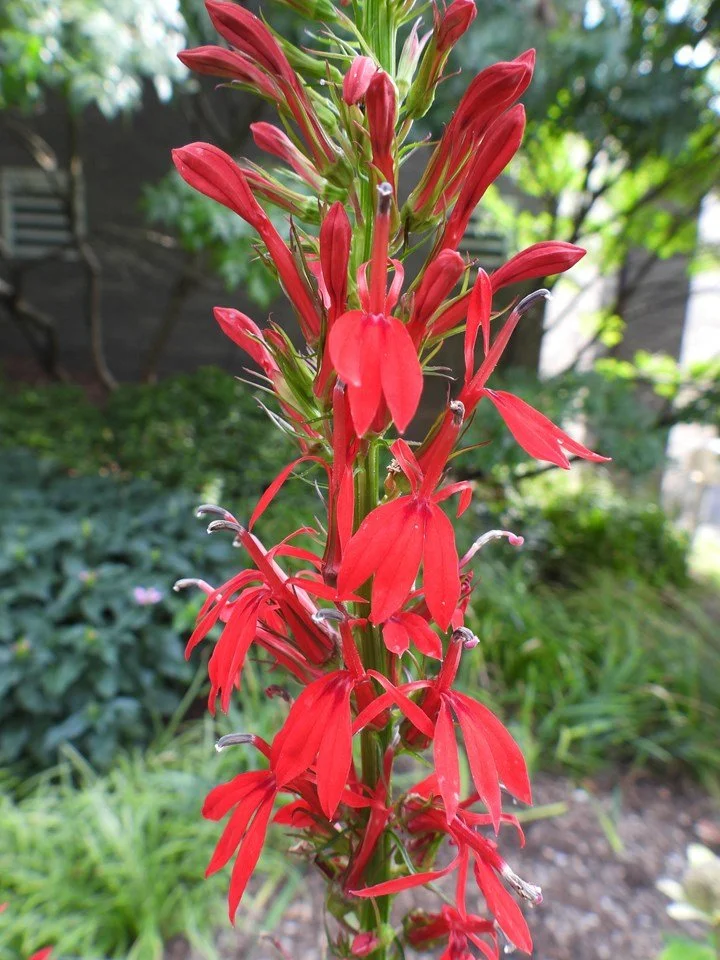
Lobelia cardinalis, commonly called cardinal flower is a native perennial which typically grows in moist locations along streams, sloughs, springs, swamps and in low wooded areas. A somewhat short-lived, clump-forming perennial which features erect, terminal spikes (racemes) of large, cardinal red flowers on unbranched, alternate-leafed stalks rising typically to a height of 2-3' (infrequently to 4'). Tubular flowers are 2-lipped, with the three lobes of the lower lip appearing more prominent than the two lobes of the upper lip. Finely-toothed, lance-shaped, dark green leaves (to 4" long). Late summer bloom period. Flowers are very attractive to butterflies and hummingbirds, but not cardinals. White and rose colored forms are also known.
Genus name honors Matthias de l'Obel (1538-1616), French physician and botanist, who with Pierre Pena wrote Stirpium Adversaria Nova (1570) which detailed a new plant classification system based upon leaves.
Specific epithet means scarlet or cardinal red.
Common name is in reference to the red robes worn by Roman Catholic cardinals.
No serious insect or disease problems. Snails and slugs may damage the foliage. Some hybrid lobelias have not performed well at the Kemper Center in St. Louis for reasons that at this point are unclear. Foliage contains alkaloids which are very toxic to humans if ingested.
Type: Herbaceous perennial
Height: 2-3 feet
Spread: 1-2 feet
Bloom Time: July to September
Bloom Description: Scarlet red, white or rose
Sun: Full sun to part shade
Water: Medium to wet
Maintenance: Low
Attracts: Hummingbirds, Butterflies
Tolerate: Rabbit, Deer, Wet Soil
Easily grown in rich, medium to wet soils in full sun to part shade. Needs constant moisture. Tolerates brief flooding. Soils should never be allowed to dry out. Will tolerate full sun in cool, northern climates, but otherwise appreciates part shade. Root mulch should be applied in cold winter climates to protect the root system and to prevent root heaving. Mulch will also help retain soil moisture.
Lobelia cardinalis, commonly called cardinal flower is a native perennial which typically grows in moist locations along streams, sloughs, springs, swamps and in low wooded areas. A somewhat short-lived, clump-forming perennial which features erect, terminal spikes (racemes) of large, cardinal red flowers on unbranched, alternate-leafed stalks rising typically to a height of 2-3' (infrequently to 4'). Tubular flowers are 2-lipped, with the three lobes of the lower lip appearing more prominent than the two lobes of the upper lip. Finely-toothed, lance-shaped, dark green leaves (to 4" long). Late summer bloom period. Flowers are very attractive to butterflies and hummingbirds, but not cardinals. White and rose colored forms are also known.
Genus name honors Matthias de l'Obel (1538-1616), French physician and botanist, who with Pierre Pena wrote Stirpium Adversaria Nova (1570) which detailed a new plant classification system based upon leaves.
Specific epithet means scarlet or cardinal red.
Common name is in reference to the red robes worn by Roman Catholic cardinals.
No serious insect or disease problems. Snails and slugs may damage the foliage. Some hybrid lobelias have not performed well at the Kemper Center in St. Louis for reasons that at this point are unclear. Foliage contains alkaloids which are very toxic to humans if ingested.