

 Image 1 of 2
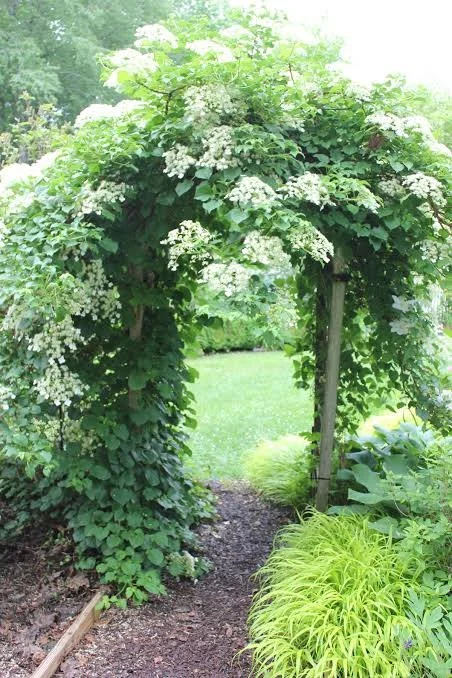 Image 2 of 2
Hydrangea anomala
Height: 30 to 50 feet
Spread: 5 to 6 feet
Bloom Time: May to July
Sun: Part shade to full shade
Water: Medium
Maintenance: Low
Flower: Showy, Fragrant, Good Cut
Leaf: Good Fall
Other: Winter Interest
Tolerate: Rabbit, Drought, Heavy Shade
Deadheading: If your climbing hydrangea doesn’t need pruning, just remove old, wilted blooms to keep the plant looking tidy. Maintenance pruning: Cutting back hydrangea vines is best done immediately after flowering, before new buds appear. Otherwise, you risk cutting off flower buds that appear soon after flowering, thus drastically reducing development of new blooms for the upcoming year. Winter-killed growth: Dead or damaged growth should be removed in early spring, when buds are appearing or just beginning to open. However, damaged growth can be removed as needed any time of year. Staggered pruning for overgrown plants: If the climbing hydrangea vine is badly overgrown, reduce the size gradually by staggering the pruning over a span of two or three years. Hard pruning of old or badly neglected plants: Old, neglected vines can be cut to the ground. This means you won’t enjoy blooms the coming season, but the rejuvenated plant should come back better than ever the following year.
Cutting back hydrangea vines is uninvolved; simply cut off wayward shoots just below spent blooms or at the point where the vine joins a larger stem. You can also cut off old or dead stems at the base of the plant to stimulate healthy new growth. Always use clean, sharp pruners when cutting back hydrangea vines.
Best grown in rich, fertile, moist but well-drained soils in part shade to full shade. Tolerates full sun only if grown with consistently moist soils.
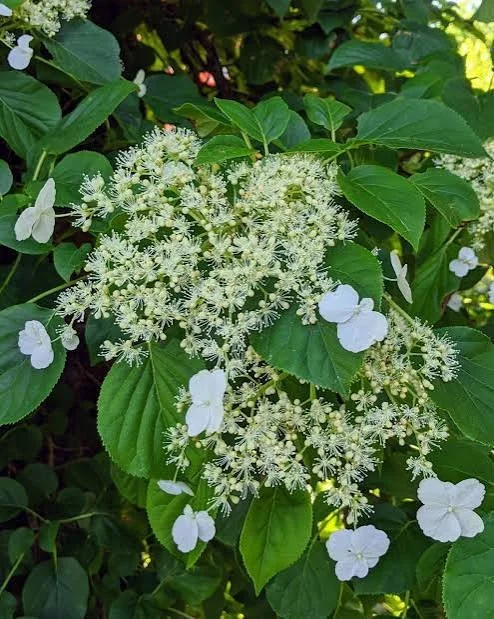
Hydrangea anomala, commonly known as climbing hydrangea, is a vigorous, sprawling, deciduous, woody vine that clings and climbs by twining and aerial rootlets along the stems, typically maturing over time to 30-40’ long. Horizontal lateral branching often extends several feet beyond supporting structures. Unsupported vines sometimes will grow in the form of a mounding shrub to 3-4’ tall, sprawling along the ground like a ground cover eventually covering an area of up to 200 square feet. This plant is native to wooded valleys, stream banks and mountain slopes in the Himalayas and China. Opposite, simple, serrate, ovate, dark green leaves (to 4” long) have cordate bases and turn shades of yellow in fall. Fragrant white flowers in flat-topped clusters (to 8” wide) bloom in late spring to early summer (May-June). Each flower cluster consists of non-showy, creamy white to greenish-yellow fertile flowers in the center surrounded by showy white sterile flowers. Dried flower heads are reddish brown. Exfoliating bark on mature stems is also reddish brown and attractive in winter. Fruit ripens in September-October. Flattened clusters (corymbs 6-10” wide) of fragrant, white flowers in a lacecap configuration (small creamy white to greenish yellow fertile flowers in the center with a marginal ring of showy white sterile flowers) bloom in late spring to early summer (June-July). Fewer than 10 stamens per flower. Exfoliating, reddish brown bark of mature plants is attractive in winter. Once established, this vine can develop a somewhat bushy habit, with lateral branches growing out several feet from the support structure, thus giving the foliage a somewhat tiered effect.
The genus name Hydrangea comes from hydor meaning "water" and aggeion meaning "vessel", in reference to the cup-like capsular fruits.
Specific epithet comes from the Greek word anomalas in reference to the vine-like plant habit.
No serious insect or disease problems. Needs a strong support structure if grown vertically on walls, fences or into large trees.
Hydrangea anomala
Height: 30 to 50 feet
Spread: 5 to 6 feet
Bloom Time: May to July
Sun: Part shade to full shade
Water: Medium
Maintenance: Low
Flower: Showy, Fragrant, Good Cut
Leaf: Good Fall
Other: Winter Interest
Tolerate: Rabbit, Drought, Heavy Shade
Deadheading: If your climbing hydrangea doesn’t need pruning, just remove old, wilted blooms to keep the plant looking tidy. Maintenance pruning: Cutting back hydrangea vines is best done immediately after flowering, before new buds appear. Otherwise, you risk cutting off flower buds that appear soon after flowering, thus drastically reducing development of new blooms for the upcoming year. Winter-killed growth: Dead or damaged growth should be removed in early spring, when buds are appearing or just beginning to open. However, damaged growth can be removed as needed any time of year. Staggered pruning for overgrown plants: If the climbing hydrangea vine is badly overgrown, reduce the size gradually by staggering the pruning over a span of two or three years. Hard pruning of old or badly neglected plants: Old, neglected vines can be cut to the ground. This means you won’t enjoy blooms the coming season, but the rejuvenated plant should come back better than ever the following year.
Cutting back hydrangea vines is uninvolved; simply cut off wayward shoots just below spent blooms or at the point where the vine joins a larger stem. You can also cut off old or dead stems at the base of the plant to stimulate healthy new growth. Always use clean, sharp pruners when cutting back hydrangea vines.
Best grown in rich, fertile, moist but well-drained soils in part shade to full shade. Tolerates full sun only if grown with consistently moist soils.
Hydrangea anomala, commonly known as climbing hydrangea, is a vigorous, sprawling, deciduous, woody vine that clings and climbs by twining and aerial rootlets along the stems, typically maturing over time to 30-40’ long. Horizontal lateral branching often extends several feet beyond supporting structures. Unsupported vines sometimes will grow in the form of a mounding shrub to 3-4’ tall, sprawling along the ground like a ground cover eventually covering an area of up to 200 square feet. This plant is native to wooded valleys, stream banks and mountain slopes in the Himalayas and China. Opposite, simple, serrate, ovate, dark green leaves (to 4” long) have cordate bases and turn shades of yellow in fall. Fragrant white flowers in flat-topped clusters (to 8” wide) bloom in late spring to early summer (May-June). Each flower cluster consists of non-showy, creamy white to greenish-yellow fertile flowers in the center surrounded by showy white sterile flowers. Dried flower heads are reddish brown. Exfoliating bark on mature stems is also reddish brown and attractive in winter. Fruit ripens in September-October. Flattened clusters (corymbs 6-10” wide) of fragrant, white flowers in a lacecap configuration (small creamy white to greenish yellow fertile flowers in the center with a marginal ring of showy white sterile flowers) bloom in late spring to early summer (June-July). Fewer than 10 stamens per flower. Exfoliating, reddish brown bark of mature plants is attractive in winter. Once established, this vine can develop a somewhat bushy habit, with lateral branches growing out several feet from the support structure, thus giving the foliage a somewhat tiered effect.
The genus name Hydrangea comes from hydor meaning "water" and aggeion meaning "vessel", in reference to the cup-like capsular fruits.
Specific epithet comes from the Greek word anomalas in reference to the vine-like plant habit.
No serious insect or disease problems. Needs a strong support structure if grown vertically on walls, fences or into large trees.