

 Image 1 of 2
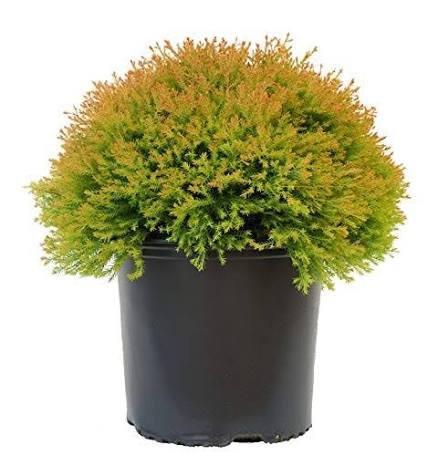 Image 2 of 2
Thuja Occidentalis 'Congabe' PP19009
LIGHT: Full sun - Part Sun
WATER: Water when top 2 inches of soil is dry.
SIZE: Reaches 2 ft. tall and wide in 10 years; 4 ft. tall and wide at maturity.
Class: Evergreen
Special FeaturesDramatic Foliage Color, Easy Care, Compact Form
Growth RateModerate
Foliage Color: Green, Yellow, Red
Care: Care is refreshingly simple: little to no pruning is required to maintain its ball form. If needed, lightly shear after the spring flush. Feed in early spring with a balanced, slow‑release fertilizer. Check site drainage in winter-rainy climates; consistently soggy soils can stress plants. In colder zones within its range, a late‑fall deep watering before freeze helps reduce winter desiccation.
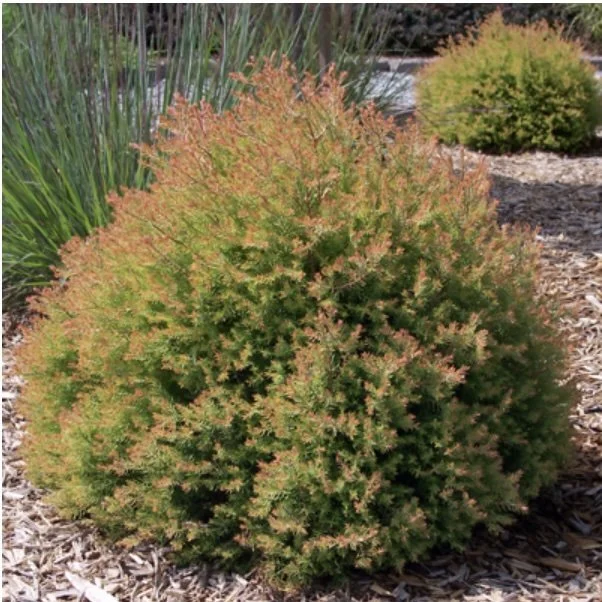
Distinctive color shifts set Fire Chief apart among compact evergreens. Bright gold foliage brightens the tidy globe-shaped shrub in spring. Summer brings gentle hues of orange which deepen to red in fall. No pruning; resists sun and wind burn.
Size, Habit & Landscape Uses: With a mature size of 2–4 feet tall and wide, this compact arborvitae bush slots easily into foundation beds, mixed borders, and courtyards. Use one as a glowing specimen, group several for a colorful rhythm through a border, or line a path with a series of soft, spherical forms. In containers, a single plant brings four‑season interest to porches and patios. Its even, globe‑shaped habit also makes a cheerful color punctuation among darker evergreens and blue‑green conifers.
Light, Soil & Water: Fire Chief thrives in full sun to partial shade; more sun typically brings stronger golds and reds, while light shade can soften tones. Provide well‑drained soil—average garden loam is fine. Water regularly the first season to establish, then water deeply but less often once roots are set. Mulch 2–3 inches to moderate soil moisture and temperature.
Spacing & Design Notes: For a seamless drift or low edging, Fire Chief Arborvitae spacing of 3 feet on center typically yields a soft, contiguous line at maturity; widen to 4–5 feet if you prefer distinct spheres with air between. Tuck Fire Chief near dark‑leafed hollies, blue junipers, or burgundy loropetalum to amplify its gold‑to‑red color show.
Winter Performance: Expect consistently warm tones in winter—gold washed with orange‑red—while interior foliage remains greener, adding depth. Its genetics and dense habit help it resist sun and wind burn, especially when sited out of direct winter wind corridors and kept properly watered into dormancy.Care:
Grow in average, medium moisture, well-drained soils in full sun to part shade. Somewhat wide range of soil tolerance, but prefers moist, neutral to alkaline, well-drained loams. Intolerant of dry conditions. Best in full sun, but generally appreciates some light afternoon shade in hot summer climates. Avoid full shade where foliage density will substantially decrease. Avoid exposed, windy sites.
Thuja occidentalis, commonly known as American arborvitae, Eastern arborvitae, Eastern white cedar or Northern white cedar, is a dense, conical to narrow-pyramidal (sometimes maturing to broad-pyramidal), often single-trunked, evergreen tree that is native to eastern and central Canada south to northern Illinois, Ohio and New York with scattered populations further south in the Appalachians to North Carolina.
The genus name Thuja comes from the Greek thyia, a name given to a fragrant evergreen tree of uncertain identification but variously theorized to be Tetraclinis articulata or Juniperus foetidissima.
Specific epithet means from the Western (Occidental) world.
The common name of arborvitae (tree of life) comes from early French settlers to North America who learned from Native Americans that the tree’s foliage could be used to treat scurvy.
Bagworms, mealybug, scales and spider mites are occasional visitors. Susceptible to damage/stem breakage in winter from ice and snow accumulations.
Thuja Occidentalis 'Congabe' PP19009
LIGHT: Full sun - Part Sun
WATER: Water when top 2 inches of soil is dry.
SIZE: Reaches 2 ft. tall and wide in 10 years; 4 ft. tall and wide at maturity.
Class: Evergreen
Special FeaturesDramatic Foliage Color, Easy Care, Compact Form
Growth RateModerate
Foliage Color: Green, Yellow, Red
Care: Care is refreshingly simple: little to no pruning is required to maintain its ball form. If needed, lightly shear after the spring flush. Feed in early spring with a balanced, slow‑release fertilizer. Check site drainage in winter-rainy climates; consistently soggy soils can stress plants. In colder zones within its range, a late‑fall deep watering before freeze helps reduce winter desiccation.
Distinctive color shifts set Fire Chief apart among compact evergreens. Bright gold foliage brightens the tidy globe-shaped shrub in spring. Summer brings gentle hues of orange which deepen to red in fall. No pruning; resists sun and wind burn.
Size, Habit & Landscape Uses: With a mature size of 2–4 feet tall and wide, this compact arborvitae bush slots easily into foundation beds, mixed borders, and courtyards. Use one as a glowing specimen, group several for a colorful rhythm through a border, or line a path with a series of soft, spherical forms. In containers, a single plant brings four‑season interest to porches and patios. Its even, globe‑shaped habit also makes a cheerful color punctuation among darker evergreens and blue‑green conifers.
Light, Soil & Water: Fire Chief thrives in full sun to partial shade; more sun typically brings stronger golds and reds, while light shade can soften tones. Provide well‑drained soil—average garden loam is fine. Water regularly the first season to establish, then water deeply but less often once roots are set. Mulch 2–3 inches to moderate soil moisture and temperature.
Spacing & Design Notes: For a seamless drift or low edging, Fire Chief Arborvitae spacing of 3 feet on center typically yields a soft, contiguous line at maturity; widen to 4–5 feet if you prefer distinct spheres with air between. Tuck Fire Chief near dark‑leafed hollies, blue junipers, or burgundy loropetalum to amplify its gold‑to‑red color show.
Winter Performance: Expect consistently warm tones in winter—gold washed with orange‑red—while interior foliage remains greener, adding depth. Its genetics and dense habit help it resist sun and wind burn, especially when sited out of direct winter wind corridors and kept properly watered into dormancy.Care:
Grow in average, medium moisture, well-drained soils in full sun to part shade. Somewhat wide range of soil tolerance, but prefers moist, neutral to alkaline, well-drained loams. Intolerant of dry conditions. Best in full sun, but generally appreciates some light afternoon shade in hot summer climates. Avoid full shade where foliage density will substantially decrease. Avoid exposed, windy sites.
Thuja occidentalis, commonly known as American arborvitae, Eastern arborvitae, Eastern white cedar or Northern white cedar, is a dense, conical to narrow-pyramidal (sometimes maturing to broad-pyramidal), often single-trunked, evergreen tree that is native to eastern and central Canada south to northern Illinois, Ohio and New York with scattered populations further south in the Appalachians to North Carolina.
The genus name Thuja comes from the Greek thyia, a name given to a fragrant evergreen tree of uncertain identification but variously theorized to be Tetraclinis articulata or Juniperus foetidissima.
Specific epithet means from the Western (Occidental) world.
The common name of arborvitae (tree of life) comes from early French settlers to North America who learned from Native Americans that the tree’s foliage could be used to treat scurvy.
Bagworms, mealybug, scales and spider mites are occasional visitors. Susceptible to damage/stem breakage in winter from ice and snow accumulations.