Image 1 of 2
Image 2 of 2
Inkberry 'Strong Box'
Plant Type: Native Evergreen Shrub
Garden Height: 24 - 36 Inches
Spread: 24 - 36 Inches
Flower Colors: White
Native alternative to boxwood.
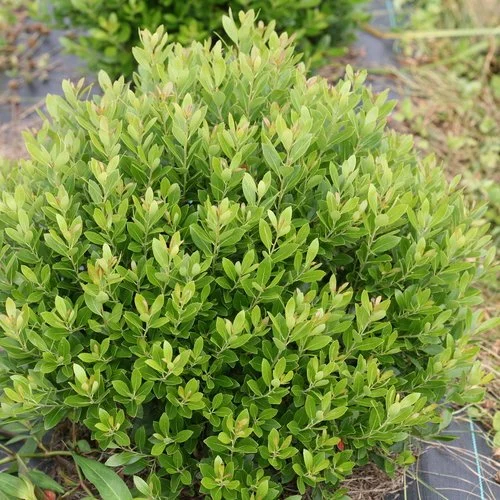
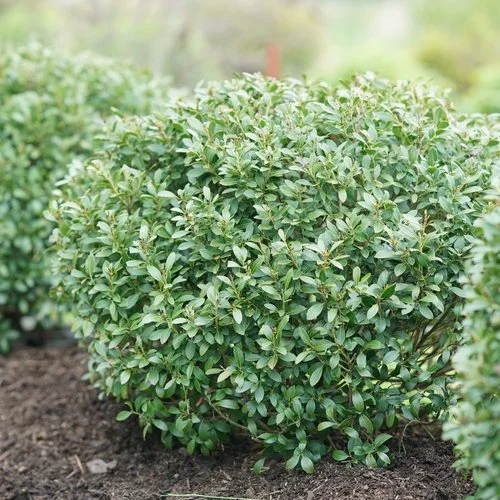
Love boxwood but struggle with disease or winter damage? Plant Strongbox® inkberry holly instead. This native evergreen naturally grows as a broadly rounded mound, and keeps its leaves all the way to the ground for the lush, dense look you love. It can be pruned or shaped as you desire, or left to attain its neat natural shape. It's also much faster growing than boxwood, and offers good deer resistance, too.
Care:
Easily grown in average, medium to wet soils in full sun to part shade. Adaptable to both light and heavy soils. Tolerates wet soils. Prefers rich, consistently moist, acidic soils in full sun. Good shade tolerance, however. Avoid neutral to alkaline soils. Inkberries are dioecious (separate male and female plants). Female plants need a male pollinator in order to produce the berry-like drupes that are characteristic of the species and cultivars. Prune to shape in early spring just before new growth begins. Plants generally need minimal pruning unless used as a hedge (perhaps best grown as an informal hedge). Remove root suckers regularly if colonial spread is not desired.
Noteworthy Characteristics
It is native to the coastal plain from Nova Scotia to Florida to Louisiana where it is most commonly found in sandy woods and peripheries of swamps and bogs. Spineless, flat, ovate to elliptic, glossy, dark green leaves (to 1.5” long) have smooth margins with several marginal teeth near the apex. Leaves usually remain attractive in winter unless temperatures dip well below zero. Greenish white flowers (male in cymes and female in cymes or single) appear in spring, but are relatively inconspicuous. If pollinated, female flowers give way to pea-sized, jet black, berry-like drupes (inkberries to 3/8" diameter) which mature in early fall and persist throughout winter to early spring unless consumed by local bird populations. Gallberry honey is a highly-rated honey that results from bees feeding on inkberry flowers. This honey is locally produced in certain parts of the Southeastern U.S. in areas where beekeepers release bees from late April to early June to coincide with inkberry flowering time. Dried and roasted inkberry leaves were first used by Native Americans to brew a black tea-like drink, hence the sometimes used common name of Appalachian tea for this shrub.
Genus name comes from the Latin name Quercus ilex for holm oak in reference to the foliage similarities (holm oak and many of the shrubs in the genus Ilex have evergreen leaves).
Specific epithet means smooth in reference to plant leaf surfaces.
Problems
Leaf spot is an occasional problem. Susceptible to chlorosis (yellowing of leaves) in high pH (alkaline) soils. Spider mites may appear, especially in dry conditions. Susceptible to inkberry leaf miner.
Plant Type: Native Evergreen Shrub
Garden Height: 24 - 36 Inches
Spread: 24 - 36 Inches
Flower Colors: White
Native alternative to boxwood.
Love boxwood but struggle with disease or winter damage? Plant Strongbox® inkberry holly instead. This native evergreen naturally grows as a broadly rounded mound, and keeps its leaves all the way to the ground for the lush, dense look you love. It can be pruned or shaped as you desire, or left to attain its neat natural shape. It's also much faster growing than boxwood, and offers good deer resistance, too.
Care:
Easily grown in average, medium to wet soils in full sun to part shade. Adaptable to both light and heavy soils. Tolerates wet soils. Prefers rich, consistently moist, acidic soils in full sun. Good shade tolerance, however. Avoid neutral to alkaline soils. Inkberries are dioecious (separate male and female plants). Female plants need a male pollinator in order to produce the berry-like drupes that are characteristic of the species and cultivars. Prune to shape in early spring just before new growth begins. Plants generally need minimal pruning unless used as a hedge (perhaps best grown as an informal hedge). Remove root suckers regularly if colonial spread is not desired.
Noteworthy Characteristics
It is native to the coastal plain from Nova Scotia to Florida to Louisiana where it is most commonly found in sandy woods and peripheries of swamps and bogs. Spineless, flat, ovate to elliptic, glossy, dark green leaves (to 1.5” long) have smooth margins with several marginal teeth near the apex. Leaves usually remain attractive in winter unless temperatures dip well below zero. Greenish white flowers (male in cymes and female in cymes or single) appear in spring, but are relatively inconspicuous. If pollinated, female flowers give way to pea-sized, jet black, berry-like drupes (inkberries to 3/8" diameter) which mature in early fall and persist throughout winter to early spring unless consumed by local bird populations. Gallberry honey is a highly-rated honey that results from bees feeding on inkberry flowers. This honey is locally produced in certain parts of the Southeastern U.S. in areas where beekeepers release bees from late April to early June to coincide with inkberry flowering time. Dried and roasted inkberry leaves were first used by Native Americans to brew a black tea-like drink, hence the sometimes used common name of Appalachian tea for this shrub.
Genus name comes from the Latin name Quercus ilex for holm oak in reference to the foliage similarities (holm oak and many of the shrubs in the genus Ilex have evergreen leaves).
Specific epithet means smooth in reference to plant leaf surfaces.
Problems
Leaf spot is an occasional problem. Susceptible to chlorosis (yellowing of leaves) in high pH (alkaline) soils. Spider mites may appear, especially in dry conditions. Susceptible to inkberry leaf miner.