

 Image 1 of 2
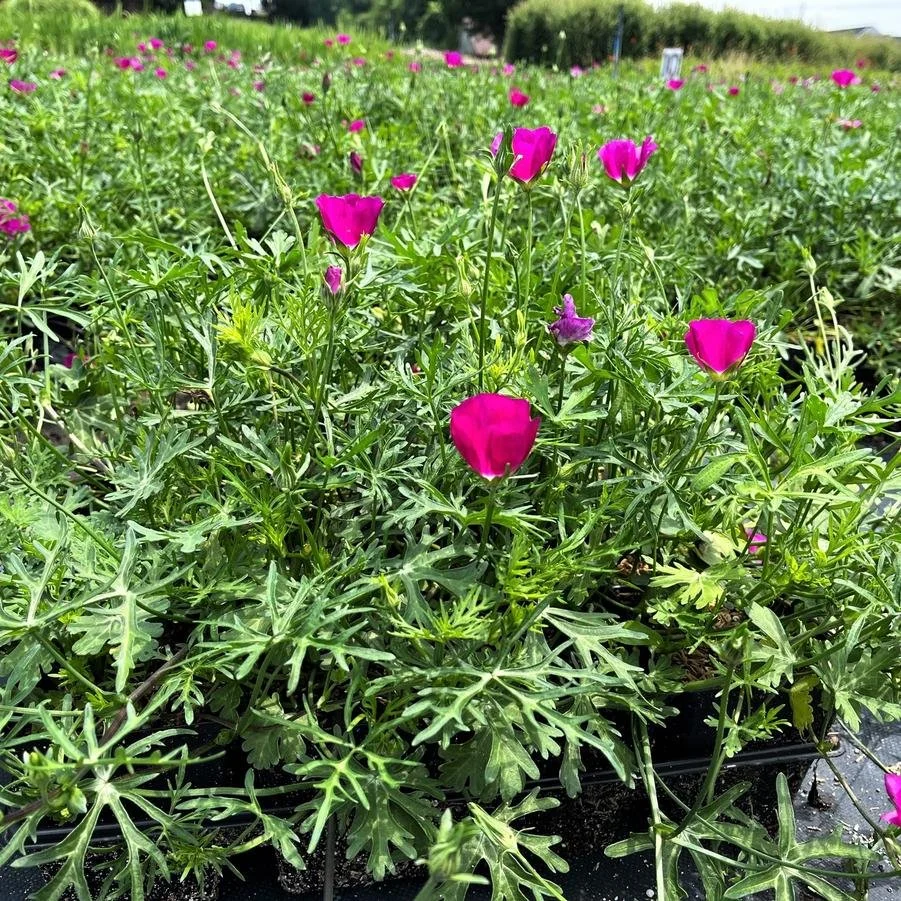 Image 2 of 2
Callirhoe involucrata
Native, mat forming perennial with green lobed leaves.
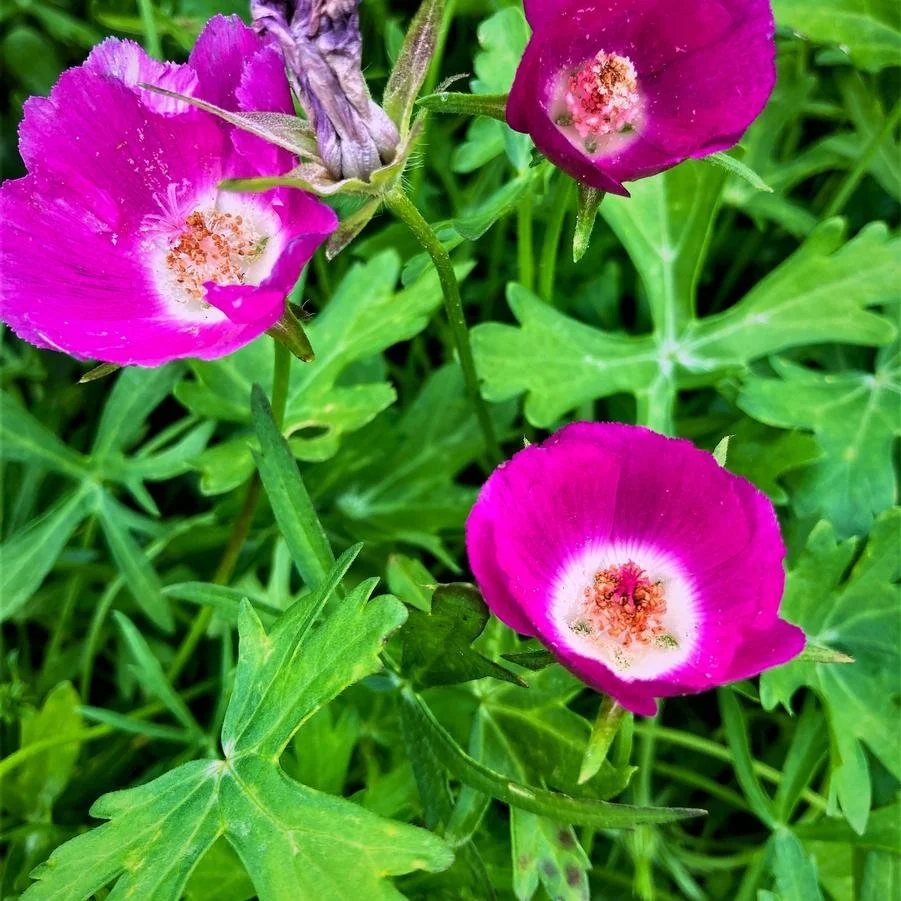
In late spring and summer, plants are covered with magenta cup shaped blossoms with white throats.
Attractive to pollinators and butterflies.
Sun/pt sun.
Category: Perennials, Natives
Height: 6-12 in
Spread: 12-36 in
Bloom Color: Magenta
Foliage Color: Green
Easily grown in dry to medium moisture, well-drained soils in full sun. Grows well from seed and may self-seed in the garden in optimum growing conditions. Long tap root gives plant good drought tolerance but makes transplanting of established plants difficult.
Callirhoe involucrata, commonly called purple poppy mallow, is a mat-forming perennial which most frequently occurs in dryish, rocky soils in prairies, fields and along roadsides throughout the semi-arid, south-central portion of the Great Plains of the United States with scattered, adventive populations to the east and west. Plants typically form a low foliage mound from 6-9" tall on procumbent stems which spread along the ground to 3' wide. Solitary, upward facing, cup-shaped, five-petaled, poppy-like, magenta flowers (to 2.5" wide) continuously appear on thin stems above the foliage from mid-spring to fall. Stamens form a prominent central column typical of mallow family members, but with distinctive style branches. Leaves are palmately divided into 5-7 finger-like lobes.
Genus name honors the daughter of a minor Greek deity, Achelous, a river god.
Specific epithet means with an involucre, a ring of bracts surrounding several flowers.
No serious insect or disease problems. Crown rot may occur in poorly drained soils.
Good native ground cover. Border fronts, rock gardens, native plant gardens, wild gardens, naturalized areas or meadows. Sprawl over a stone wall. Fits well into both formal garden areas as well as wild/naturalized areas.
Callirhoe involucrata
Native, mat forming perennial with green lobed leaves.
In late spring and summer, plants are covered with magenta cup shaped blossoms with white throats.
Attractive to pollinators and butterflies.
Sun/pt sun.
Category: Perennials, Natives
Height: 6-12 in
Spread: 12-36 in
Bloom Color: Magenta
Foliage Color: Green
Easily grown in dry to medium moisture, well-drained soils in full sun. Grows well from seed and may self-seed in the garden in optimum growing conditions. Long tap root gives plant good drought tolerance but makes transplanting of established plants difficult.
Callirhoe involucrata, commonly called purple poppy mallow, is a mat-forming perennial which most frequently occurs in dryish, rocky soils in prairies, fields and along roadsides throughout the semi-arid, south-central portion of the Great Plains of the United States with scattered, adventive populations to the east and west. Plants typically form a low foliage mound from 6-9" tall on procumbent stems which spread along the ground to 3' wide. Solitary, upward facing, cup-shaped, five-petaled, poppy-like, magenta flowers (to 2.5" wide) continuously appear on thin stems above the foliage from mid-spring to fall. Stamens form a prominent central column typical of mallow family members, but with distinctive style branches. Leaves are palmately divided into 5-7 finger-like lobes.
Genus name honors the daughter of a minor Greek deity, Achelous, a river god.
Specific epithet means with an involucre, a ring of bracts surrounding several flowers.
No serious insect or disease problems. Crown rot may occur in poorly drained soils.
Good native ground cover. Border fronts, rock gardens, native plant gardens, wild gardens, naturalized areas or meadows. Sprawl over a stone wall. Fits well into both formal garden areas as well as wild/naturalized areas.