

 Image 1 of 2
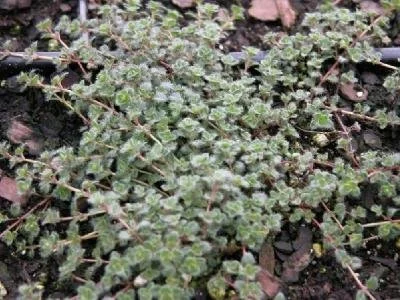 Image 2 of 2
Thymus pseudolanuginosus
Gray mats of soft, aromatic foliage
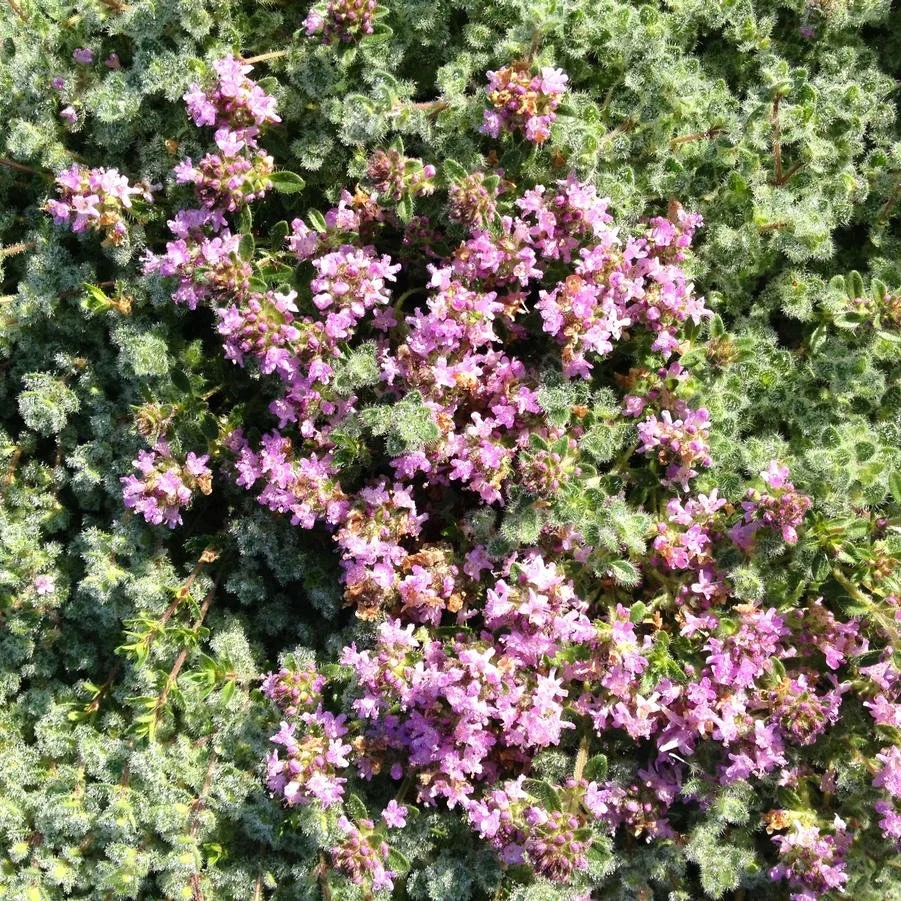
Pink flowers. Good groundcover or rock garden plant
Category: Perennials
Hardiness Zone: 6-7
Height: 2 in
Spread: 12 in
Bloom Color: Pink
Easily grown in average, dry to medium, well-drained soils in full sun. Tolerates drought and poor soils or somewhat low fertility. Loose, sandy or rocky soils with excellent drainage are best. Dislikes moist to wet soils where it will quickly rot. Cut back stems as necessary to maintain plant appearance or to control growth/spread or limit unsightly woody stem growth.
Thymus pseudolanuginosus, commonly called woolly thyme, is a creeping, woody based perennial which is used as a ground cover. Hairy stems (this is the woolliest of the thymes) give rise to the common name. Stems form a flat mat often no more than 1/2" tall but spreading to 12" wide. Very tiny, elliptic, gray leaves (to 1/8"). Leaves have little if any fragrance and are unsuitable for culinary use. Tiny, tubular, pale pink flowers appear in the leaf axils in summer in a somewhat sparse bloom. Flowers are attractive to bees.
Genus name comes from the Greek word thymos (name used in ancient Greece for a species of Thymus or Satureja).
Specific epithet means false-wool. It looks very much like wool but is not true wool, which, of course, comes from sheep (and other animals).
No serious insect or disease problem. Susceptible to root rot, particularly in moist, poorly-drained soils.
Thymus pseudolanuginosus
Gray mats of soft, aromatic foliage
Pink flowers. Good groundcover or rock garden plant
Category: Perennials
Hardiness Zone: 6-7
Height: 2 in
Spread: 12 in
Bloom Color: Pink
Easily grown in average, dry to medium, well-drained soils in full sun. Tolerates drought and poor soils or somewhat low fertility. Loose, sandy or rocky soils with excellent drainage are best. Dislikes moist to wet soils where it will quickly rot. Cut back stems as necessary to maintain plant appearance or to control growth/spread or limit unsightly woody stem growth.
Thymus pseudolanuginosus, commonly called woolly thyme, is a creeping, woody based perennial which is used as a ground cover. Hairy stems (this is the woolliest of the thymes) give rise to the common name. Stems form a flat mat often no more than 1/2" tall but spreading to 12" wide. Very tiny, elliptic, gray leaves (to 1/8"). Leaves have little if any fragrance and are unsuitable for culinary use. Tiny, tubular, pale pink flowers appear in the leaf axils in summer in a somewhat sparse bloom. Flowers are attractive to bees.
Genus name comes from the Greek word thymos (name used in ancient Greece for a species of Thymus or Satureja).
Specific epithet means false-wool. It looks very much like wool but is not true wool, which, of course, comes from sheep (and other animals).
No serious insect or disease problem. Susceptible to root rot, particularly in moist, poorly-drained soils.