

 Image 1 of 1
Yucca filamentosa 'Color Guard'
LIGHT: Full sun, Partial sun
WATER: Once established, water if very dry.
SIZE: Fast growing; reaches 3 to 4 ft. tall, 4 ft. wide.
CLASS: Evergreen, Native, Shrub
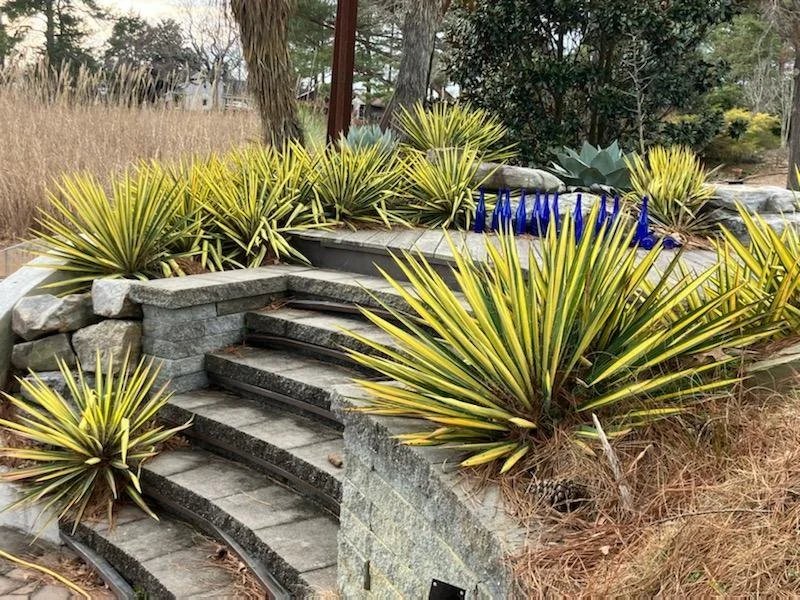
Slightly arching, sword-shaped, striped foliage of creamy-white against dark green provides great architectural interest. Showy spires of fragrant snow white blooms in summer. Ideal as an accent or container specimen, or used in mass plantings. Tolerant of wind, heat, humidity, and drought. Evergreen.
Thrives in average to lean, well-drained soil. Best in full sun, but tolerant of light shade. Water deeply and regularly during the first few growing seasons to establish an extensive root system. Once established, reduce frequency; tolerates drought. Remove spent bloom spikes. Established plants require little care.
Yucca filamentosa, commonly called Adam’s needle, Spanish bayonet, yucca and needle palm, is a virtually stemless broadleaf evergreen shrub (though it looks more like a perennial than a shrub) that is native to beaches, sand dunes and fields from South Carolina south to Florida and Mississippi. It has escaped cultivation and extended its original range north into New England. It features a basal rosette of rigid, sword-shaped, spine-tipped green leaves (to 30” long and to 4” wide) with long filamentous (as per specific epithet) curly threads along the margins. Leaves form a foliage clump to 2-3’ tall. In late spring, a flowering stalk rises from the center of each rosette, typically to 5-8’ tall, but infrequently to 12’ tall, bearing a long terminal panicles of nodding bell-shaped creamy white flowers. Fruits are elliptical dehiscent capsules. Will form a small colony over time from basal offsets.
Genus name comes from the Carbi name for manihot, also called cassava or yuca, which is not closely related but has similarly enlarged root structures.
Specific epithet means with filaments or threads.
‘Color Guard’ is a gold-centered variegated form. It features leaves with green margins and striking creamy gold centers. Long filamentous curly white threads are found along the leaf margins.
No serious insect or disease problems. Deer tend to avoid this plant.
Yucca filamentosa 'Color Guard'
LIGHT: Full sun, Partial sun
WATER: Once established, water if very dry.
SIZE: Fast growing; reaches 3 to 4 ft. tall, 4 ft. wide.
CLASS: Evergreen, Native, Shrub
Slightly arching, sword-shaped, striped foliage of creamy-white against dark green provides great architectural interest. Showy spires of fragrant snow white blooms in summer. Ideal as an accent or container specimen, or used in mass plantings. Tolerant of wind, heat, humidity, and drought. Evergreen.
Thrives in average to lean, well-drained soil. Best in full sun, but tolerant of light shade. Water deeply and regularly during the first few growing seasons to establish an extensive root system. Once established, reduce frequency; tolerates drought. Remove spent bloom spikes. Established plants require little care.
Yucca filamentosa, commonly called Adam’s needle, Spanish bayonet, yucca and needle palm, is a virtually stemless broadleaf evergreen shrub (though it looks more like a perennial than a shrub) that is native to beaches, sand dunes and fields from South Carolina south to Florida and Mississippi. It has escaped cultivation and extended its original range north into New England. It features a basal rosette of rigid, sword-shaped, spine-tipped green leaves (to 30” long and to 4” wide) with long filamentous (as per specific epithet) curly threads along the margins. Leaves form a foliage clump to 2-3’ tall. In late spring, a flowering stalk rises from the center of each rosette, typically to 5-8’ tall, but infrequently to 12’ tall, bearing a long terminal panicles of nodding bell-shaped creamy white flowers. Fruits are elliptical dehiscent capsules. Will form a small colony over time from basal offsets.
Genus name comes from the Carbi name for manihot, also called cassava or yuca, which is not closely related but has similarly enlarged root structures.
Specific epithet means with filaments or threads.
‘Color Guard’ is a gold-centered variegated form. It features leaves with green margins and striking creamy gold centers. Long filamentous curly white threads are found along the leaf margins.
No serious insect or disease problems. Deer tend to avoid this plant.